
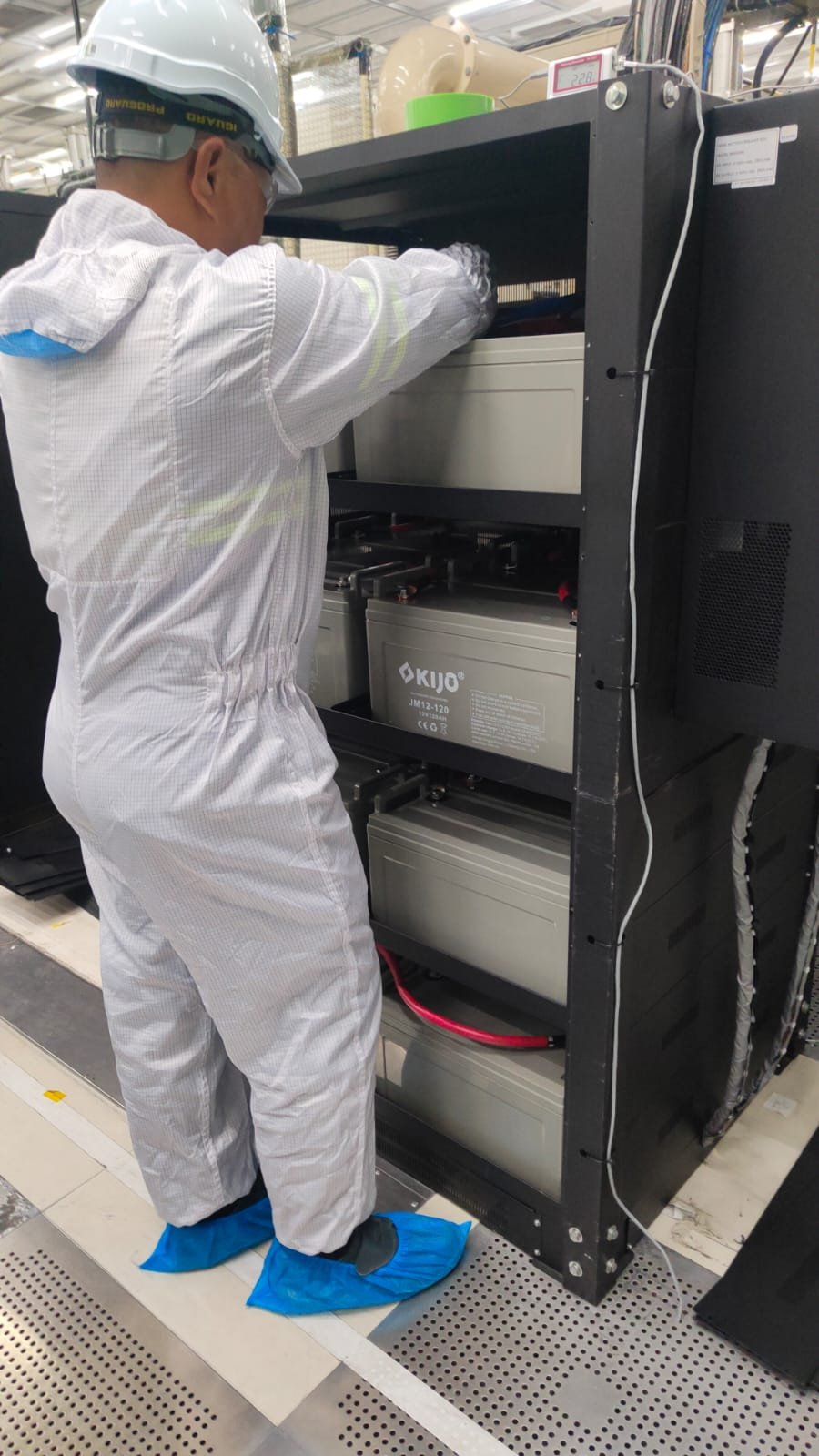
When a production line depends on clean, uninterrupted power, the battery bank behind the UPS is the part that has to work the one time you need it. Our team at NuPON UPS recently completed the installation of a new UPS battery bank for a 100 kVA unit in a cleanroom environment, safely, cleanly and verified before handover.
Quick Answer: What Did This Project Cover?
NuPON installed a complete battery bank for a 100 kVA UPS inside a working cleanroom. The team used ESD-safe cleanroom garments, mounted the batteries on a purpose-built cabinet, connected the DC string, and verified the total string voltage with a Fluke multimeter before commissioning, so the facility’s critical load stays protected against power interruptions.
Why UPS Batteries Matter for a 100 kVA System
A UPS is only as reliable as its batteries. The inverter and controls may be in perfect condition, but if the battery bank is aged, mismatched or poorly connected, the system will not carry the load through an outage. For a 100 kVA unit supporting sensitive equipment, a weak battery bank can mean:
- Shorter backup time than the facility expects
- Unplanned shutdowns of production or process equipment
- Data and product loss during voltage dips and blackouts
- Higher long-term cost from repeated emergency repairs
That is why a proper battery installation is about more than swapping units. It requires correct mounting, secure connections, voltage verification, and clear documentation.
Installation Highlights
1. Cleanroom-Ready Work Practices
Working inside a cleanroom means the job is judged on how clean it is as well as how fast it is. Our technicians worked in cleanroom-grade ESD coveralls with hoods, shoe covers and gloves, together with hard hats and eye protection. Tools and materials were kept organized and controlled so the production environment was not disturbed.

2. Properly Racked Battery Bank
The batteries were installed in a dedicated multi-tier steel cabinet with each unit seated on its own shelf. Good racking keeps the weight supported, allows airflow around each battery, keeps terminals accessible for future inspection, and keeps the installation tidy and serviceable. The installation used KIJO JM12-120 sealed lead-acid batteries (12V, 120Ah), connected with heavy-gauge, color-coded cabling.
3. Voltage Verification with a Fluke Multimeter
Before the string was connected to the UPS, our team measured the DC voltage across it with a Fluke 115 True-RMS multimeter. The reading was 403.3 V DC, recorded as the baseline for commissioning and future maintenance comparison. Checking polarity and total voltage at this stage catches wiring errors early and avoids costly surprises when the UPS is energized.

4. Safe, Enclosed, Environment-Monitored
After connection, the battery cabinet was closed and secured with panels, keeping live terminals enclosed. A temperature recorder installed above the cabinet showed ambient readings of around 22 °C during the work, a useful reminder that battery life depends heavily on operating temperature. Cooler, stable conditions help batteries last longer and perform as rated.
Safety First, Always
A 100 kVA UPS battery string carries a high DC voltage, so safe work practices are not optional. Our team follows these principles on every battery job:
- PPE at all times: insulated gloves, eye protection and head protection
- Controlled tools: insulated tools and verified test equipment
- Verified connections: polarity and voltage checks before energizing
- Teamwork: a second technician on hand to assist and observe
- Clean-up: work area left tidy and ready for the facility’s normal operations
Benefits to the Customer
- Restored backup confidence: a fresh, verified battery bank behind the UPS
- Minimal disruption: work completed with respect for the cleanroom environment
- Documented baseline: recorded voltage for future maintenance checks
- Serviceable layout: racked and labeled for easy inspection
Signs It’s Time to Replace Your UPS Batteries
- The UPS shows a battery fault or “replace battery” warning
- Backup runtime has dropped noticeably
- Batteries are swollen, leaking or discolored
- The battery bank is approaching the end of its rated service life
- Load tests or voltage checks show weak or uneven cells
Frequently Asked Questions
What does a UPS battery installation for a 100 kVA unit involve?
It involves mounting the batteries in a rated cabinet or rack, connecting them in series to form the DC string, torquing and insulating terminals, checking polarity, measuring the total DC voltage with a calibrated multimeter, and then connecting the string to the UPS and commissioning the system.
Why is voltage verification important after installing UPS batteries?
Measuring the string voltage confirms that every battery is connected with the correct polarity and that the string is healthy before it is connected to the UPS. It prevents wiring faults and gives a baseline reading for future maintenance.
Can UPS batteries be installed inside a cleanroom?
Yes, when the work follows the facility’s cleanroom protocol: cleanroom-grade garments, shoe covers and gloves, controlled tools and materials, and careful handling so no contamination or static discharge affects the production area.
How often should UPS batteries be checked or replaced?
VRLA UPS batteries should be inspected and tested on a regular schedule, and replaced at the end of their service life, which is typically a few years depending on the product, temperature and usage. Follow the manufacturer’s specification and your maintenance plan.
Power Your Critical Operations with NuPON UPS
From battery replacement to full UPS supply, installation, and maintenance, NuPON Technology Phils. Corp. helps Philippine facilities, including cleanrooms and manufacturing plants, protect their critical loads.
Need a UPS battery replacement or a health check on your existing UPS? Contact the NuPON UPS team for a site assessment and quotation.


